
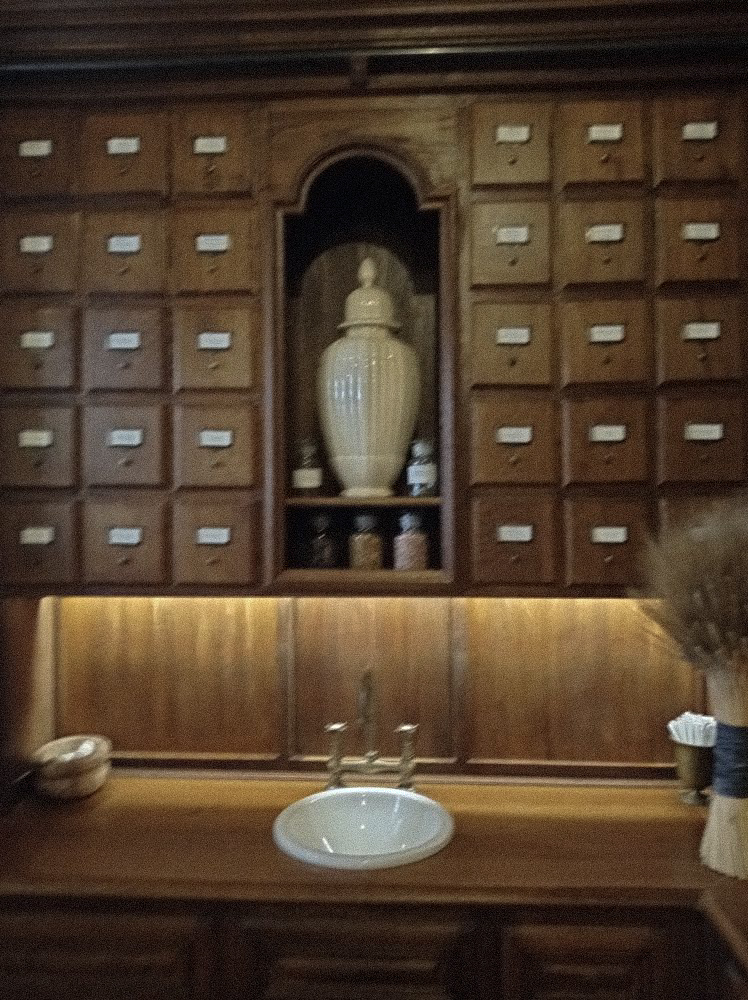
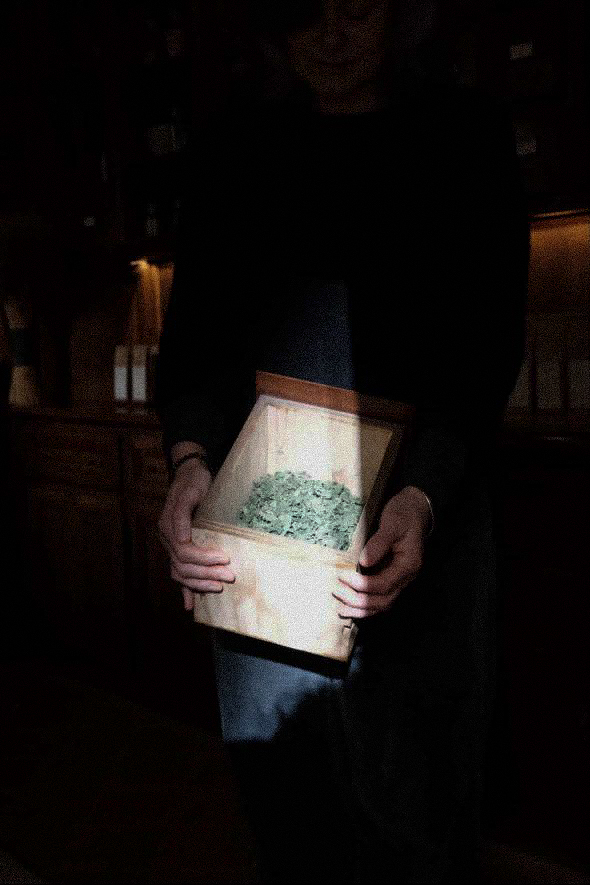
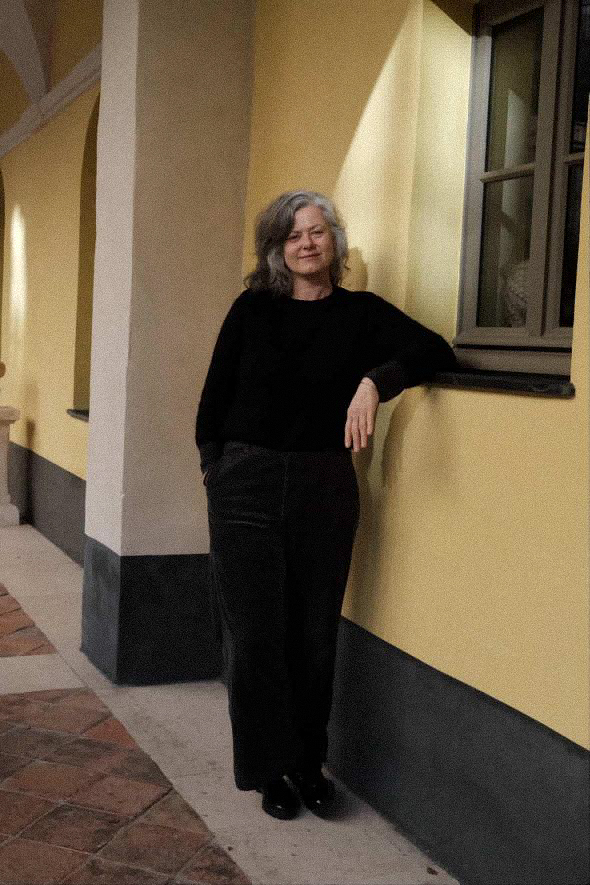
Karine Alice Brun is an herbalist and writer based in Nice. She works at the L’Herboristerie de l’Hôtel du Couvent, teaches at Fragonard, and is the author of the poetry book: La Percée. In our conversation, we discuss how she translates the subtle language of the living world, sharing it with others through observation and silence.
Repose: How would you describe what you do?
Karine: When people ask me what I do, I say that my work, maybe also my life, is about weaving intimate connections with the living world. By “living,” I mean everything around us that carries a language: plants, trees, elements. My focus is mainly on medicinal and edible plants, as this is my field of expertise. I studied herbalism, naturopathy, subtle aromatherapy, and plant-based perfumery.
Today, I see myself as a kind of mediator, translating the sensitive language of the living world and sharing it with people through care, transmission, and guidance. I accompany those who want to reconnect in a more sensitive way. My work is about listening, observing, and approaching things with humility, as if experiencing them for the first time.
Repose: What is the connection between people and plants?
Karine: There are different ways to understand this connection. You can approach it through science, but also through intuition, poetry, and the senses. We all have a non-verbal intelligence that comes from our senses, touch, smell, perception. For me, smell and emotion are essential. In French, we often say “I feel it” to describe intuition.
Plants speak through sensations, memories, and associations. When you connect with a plant, it can reveal something about how you relate to the world. My work is about helping people access that sensitivity, through observation, silence, and experience.
Repose: How did you start your journey?
Karine: I’ve had several lives. I first studied political science in Paris, then worked for the United Nations and NGOs. I was involved in education programs, especially supporting women and communities.
At that time, I wanted to change the world. Over time, that desire became more embodied and personal. A major turning point was my mother’s illness. She had Alzheimer’s, and seeing her lose connection with sensations and daily life deeply affected me. Cooking became a way to reconnect, with her, with myself, with life.
From there, I trained in cuisine, worked with plants, and naturally returned to something more essential: nature, care, and the living world.
Repose: What led you to where you are today?
Karine: Life guided me through many transformations. After working in cities like Paris and São Paulo, I moved to a small mountain village. That experience changed my life. Living close to nature, especially during the COVID period, allowed me to deepen my studies in herbalism and reconnect with myself.
At some point, I realized something important: if I wanted to take care of others, I also had to learn how to take care of myself. And for me, that answer was in nature, plants, landscapes, and silence.
Repose: What are you doing today?
Karine: Today, I divide my time between different activities. I work in an herbalist space where I advise and accompany people. I also teach perfume, lead workshops, organize walks in nature, and write.
Writing is very important to me, I published a poetry book where I share my story and my relationship to life. I also create experiences where people can reconnect with themselves through plants, scents, and words.
Repose: Do you feel that people understand the value behind your work?
Karine: I think it depends. Not everyone connects to it in the same way, and that’s completely fine. My work is quite sensitive and sometimes intangible, so it requires a certain openness. But the people who are ready for it, who feel something, they understand deeply. It’s not about being understood by everyone, but about resonating with the right people.
Repose: How do you balance taking care of others and taking care of yourself?
Karine: I walk a lot, I write, and I spend time alone in nature. Silence is very important to me. It’s not about not speaking, it’s about listening.
I often ask myself simple questions: Does this choice grow love? Does it align with my desire? Does it feel right? I don’t always have immediate answers, but this inner dialogue helps me stay balanced.
Repose: How do you connect with your audience or the right people?
Karine: I don’t try to target a specific audience. I believe in diversity and in natural connections. People come through word of mouth, through what resonates with them.
For me, it’s important to have a “situated voice”, to speak from a real place, from experience. My book, my writing, and even my presence online are ways to share that space. Then people find their way to it, if it speaks to them.
Repose: Has your project evolved from the original idea?
Karine: Yes, a lot. At the beginning, I didn’t have a clear structure or defined format. It was more intuitive, more experimental. Over time, through experiences and encounters, it became more grounded and clear. But the essence is still the same, it’s just expressed in a more embodied and precise way today.
Repose: What excites you most about your current work and the future?
Karine: What excites me is that it’s always evolving. There is no fixed form. I can explore different mediums, writing, scent, plants, experiences. It feels very alive. For the future, I don’t have a fixed plan, but I’m excited to keep exploring and deepening this relationship with the living world, and to continue sharing it with others.
Repose: Are there any philosophies or approaches that inspire you?
Karine: I’m inspired by many things, poetry, philosophy, but also very simple ways of observing life. I’m interested in presence, in attention, in slowing down. Also in the idea of humility towards the living world, of not trying to control everything but to listen and learn.
Repose: What would you tell your younger self?
Karine: To trust life more. To understand that everything, difficult moments included, is part of the process. There are no real obstacles, only ingredients of life.
And maybe also to live with more audacity. As I often say, people think poetry is useless, but love is “useless” too, and yet it’s essential.
Repose Archive is a creative direction journal documenting processes and projects across art, design, architecture, and hospitality. As designers, we interview creative minds and explore their creations. Photography credits: Yvan for Karine Alice Brun and Repose.